
Blog
Culture Wars & Judicial Politics

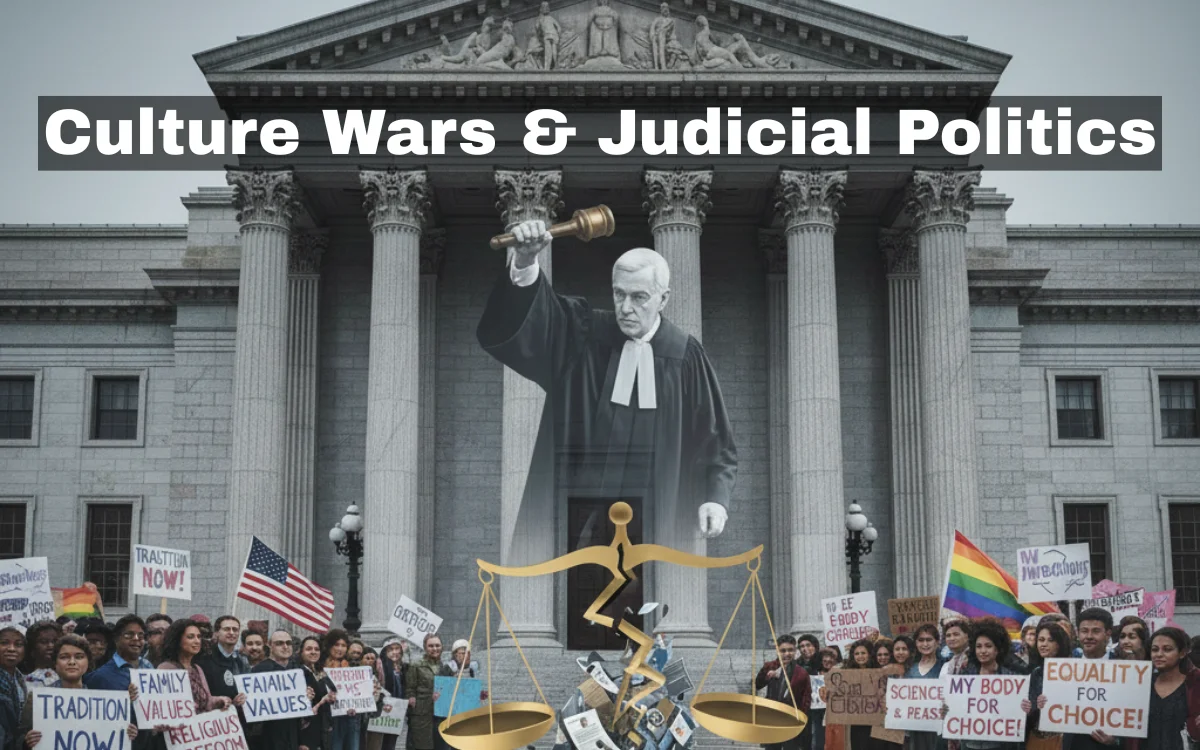
The term culture wars refers to deep political conflicts over core social and moral issues — such as abortion rights, LGBTQ rights, guns, religion, and free speech.
Judicial politics refers to the ways courts — especially the U.S. Supreme Court — are involved in deciding these contested issues, directly shaping national policy through legal rulings.
Today, these two forces are tightly linked in the U.S., and the Supreme Court is at the center of it.
🏛️ 1. The Supreme Court Has Become a Major Site of Culture War Battles
The U.S. Supreme Court, historically more of a procedural body, is now frequently ruling on highly divisive social issues:
- Cases involving abortion rights, gender and LGBTQ issues, guns, and religion are dominating its docket.
- The conservative 6-3 majority has overturned or scaled back major precedents such as Roe v. Wade, and expanded rights for gun ownership and religious expression.
- The number of high-profile culture-war cases has increased sharply in recent terms, even as the total number of cases the Court hears has declined overall.
This shift means that judicial decisions are not just technical legal interpretations — they’re directly influencing the social and moral landscape.
⚖️ 2. Key Types of Culture-War Cases Being Decided
Recent and upcoming Supreme Court cases reflect the court’s involvement in cultural and political debates:
🔹 Gender & LGBTQ Rights
- Challenges to transgender athletes’ participation policies.
- Broader questions about legal protections for transgender and nonbinary people are being litigated at high levels.
🔹 Gun Rights
- The Court may further define or expand Second Amendment protections as states contest how far gun regulations can go.
🔹 Abortion & Reproductive Rights
- Since Dobbs (which returned abortion regulation to the states), lower courts and future Supreme Court review continue to shape access to reproductive healthcare across jurisdictions.
- Related litigation also influences healthcare funding and provider protections.
🔹 Free Speech & Content Regulation
- Rulings like Free Speech Coalition v. Paxton upheld age-verification laws for online content, balancing minors’ protection against adult expression — part of the broader debate over speech and morality online.
🔹 Executive Authority & Checks and Balances
- Cases like Trump v. CASA, Inc. address judicial power limits and how broadly courts can block federal policies, influencing the balance between branches of government.
🤝 3. Why This Matters in Politics, Not Just Law
📊 Public Confidence is Mixed
Polls show a significant portion of Americans don’t view the Supreme Court as politically neutral — perceptions of partisanship are high.
This has important effects:
- People increasingly see the judiciary as part of partisan conflict.
- Court decisions are treated as political wins or losses by different ideological groups.
- Judicial appointments and rulings are a central topic in election campaigns.
🌀 4. Judicial Politics Amplifies Culture Wars
The culture war isn’t just about specific cases — it’s about how courts are perceived and how judicial power is used:
🔹 Political Influence Over Judicial Elections
In many U.S. states, judges are elected rather than appointed, and special interest spending in these races has soared — raising concerns about judicial independence and impartiality.
🔹 Calls for Court Reform
Debates about ethics rules, term limits, and whether courts should be insulated from politics entirely reflect broader partisan distrust and efforts to reshape judicial influence.
📍 Big Picture: What’s Changed
✔ The Supreme Court has shifted from a largely legal arbitral body to a major arena for social and political disputes.
✔ Culture war issues (abortion, guns, gender, religion) now shape the Court’s agenda.
✔ Judicial decisions are deeply tied to political narratives and election politics.
✔ Public confidence and perceptions about judicial neutrality are declining.
🧠 Why It Matters to Everyday People
Court decisions affect real-world issues:
- Access to healthcare and reproductive services
- Rights of LGBTQ individuals
- Gun ownership and safety laws
- How public schools handle curriculum and parental rights
- The balance of power between federal and state governments
These are not just legal technicalities — they influence everyday life, civic identity, and national direction.


