
Blog
Myanmar’s Political Struggle

🗺️ 1. Background: From Democracy to Military Rule
Myanmar’s fragile democracy, led by the National League for Democracy (NLD) and Aung San Suu Kyi, was abruptly ended by a military coup on 1 February 2021. The army accused the NLD of election fraud following its landslide victory — claims widely rejected internationally. Since then:
- The elected government was ousted.
- Aung San Suu Kyi and many political leaders were arrested.
- The military consolidated power under Commander-in-Chief Min Aung Hlaing.
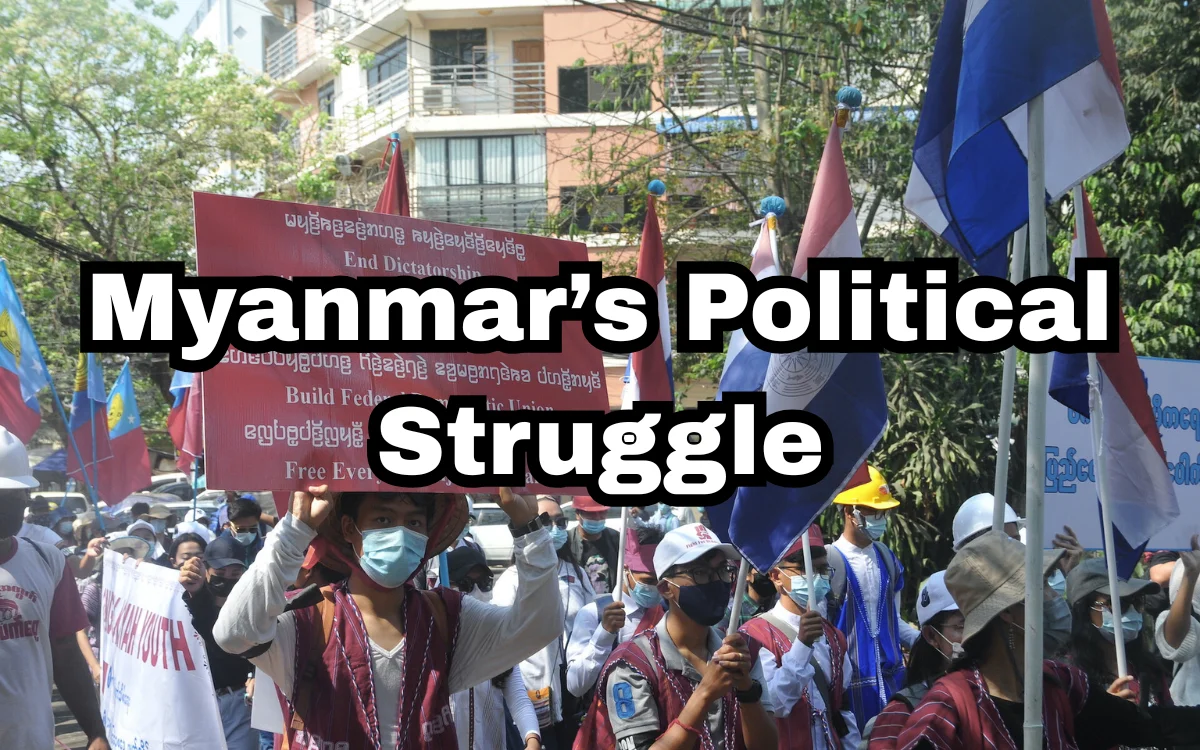
This coup did not just topple a government — it triggered widespread resistance, civil unrest, and armed insurgency across the country.
🔥 2. Ongoing Civil War and Armed Resistance
The country remains in a multi-front conflict. Various groups have taken up arms against the junta, including:
- People’s Defense Forces (PDFs) aligned with the now-exiled National Unity Government (NUG).
- Long-standing ethnic armed organizations (EAOs) like the Arakan Army and others.
These groups control significant territories and have formed alliances, such as the Spring Revolution Alliance of rebel forces pushing for federalism and human rights.
The fighting is not limited to one region — battles, airstrikes, and clashes continue in places like Shan, Kayah, Sagaing and Rakhine states, contributing to displacement, civilian casualties, and humanitarian crises.
🗳️ 3. The 2025–26 General Election: A Controversial Political Shift
After years of delaying elections, the junta has announced a multi-phase general election starting 28 December 2025, with additional phases into January 2026.
However:
- Only some areas under junta control will participate.
- Major opposition parties — including the NLD — have been dissolved or banned.
- Many pro-democracy figures remain in detention or exile.
International observers and rights groups widely view the polls as illegitimate — a bid by the military to rebrand its rule as civilian authority rather than a genuine democratic process.
The election system still reserves at least 25 % of parliamentary seats for the military under the 2008 constitution drafted under junta influence — ensuring continued armed forces leverage over politics.
🧱 4. Suppression of Dissent and Human Rights Concerns
Since the coup:
- Thousands of activists, journalists, lawyers, and ordinary citizens have been arrested or detained under harsh laws targeting dissent.
- Media outlets have been shut down, and press freedom is severely restricted.
- Many political prisoners remain behind bars as the regime uses legal and extra-legal measures to silence opposition.
Periodic amnesties, such as releases of some detainees before elections, are widely seen as token gestures rather than meaningful political liberalization.
🌏 5. International and Regional Reactions
Myanmar’s political struggle has not gone unnoticed internationally:
- ASEAN and the United Nations have expressed concern about the ongoing conflict and the legitimacy of the planned elections, with some bloc members reluctant to recognize the results.
- Western democracies have largely condemned the coup and subsequent repression.
- Some neighboring states maintain diplomatic or economic engagement, reflecting complex regional interests.
Despite international pressure, the junta appears intent on consolidating power — using elections as a tool for internal legitimacy rather than genuine democratization.
📌 In Summary: What Myanmar Is Facing Now
Political Landscape:
- The military controls the state apparatus and is staging elections to legitimize its continued rule.
- Former democratic leaders are imprisoned or silenced.
- Opposition parties and meaningful civilian political participation are largely absent.
Conflict Dynamics:
- A protracted civil war persists with multiple armed resistance groups.
- Violence continues across large parts of the country, displacing civilians and deepening humanitarian needs.
Democracy and Rights:
- Civil liberties and press freedoms are severely curtailed.
- International observers question the fairness of political processes.
Regional Impact:
- ASEAN engagement is cautious and fragmented.
- Neighboring countries navigate a balance between stability and democratic principles.


